Portfolio
Projects
Pick a project to read the full case study — each card shows the theme it tackles and the skills behind it.
SideQuest · Curatorial & Outreach Project
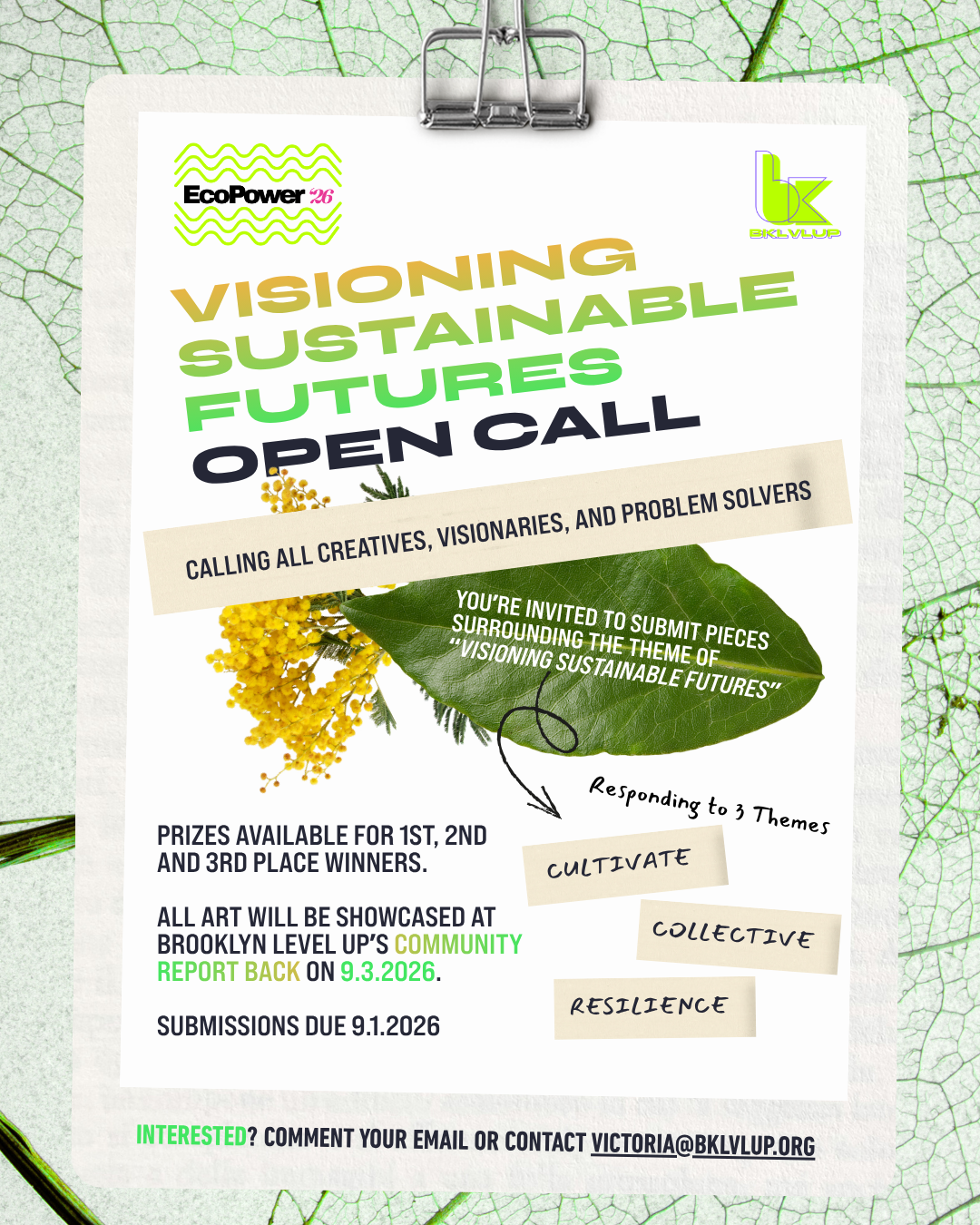
Visioning Sustainable Futures
The Challenge
Sustainability conversations rarely reach the young people who'd have the most to say about them — especially artists. I wanted a project that reflected my artistic roots and still did civic work, instead of choosing between the two.
What I Built
Visioning Sustainable Futures: an open call inviting creatives, visionaries and problem solvers across NYC to submit work responding to three themes — Cultivate, Collective, Resilience. Submissions closed 9.1.2026 and all art was showcased at Brooklyn Level Up's Community Report Back on 9.3.2026, with prizes for 1st, 2nd and 3rd place decided by community voting.
My Role
I ran it: the open call design, the outreach, the submission pipeline, and the setup on the day. The core of the work was emailing — artists, schools, organizers, anyone who might submit or spread it — and following up until the pieces came in.
Skills Used
Curation · Outreach & Email Campaign · Visual Communication · Logistics & Setup · Community Engagement
What I Learned
“Not everything is meant to end in resolution — leave space for questioning.”
Impact
Every participant had the chance to have their work installed in BKLVLUP's Community Resilience Hub. The open call was shared by several social media accounts, including one with 15K followers.
Community Research · BKLVLUP
Community Resilience Hub Survey
The survey is live — take it in your language
The Challenge
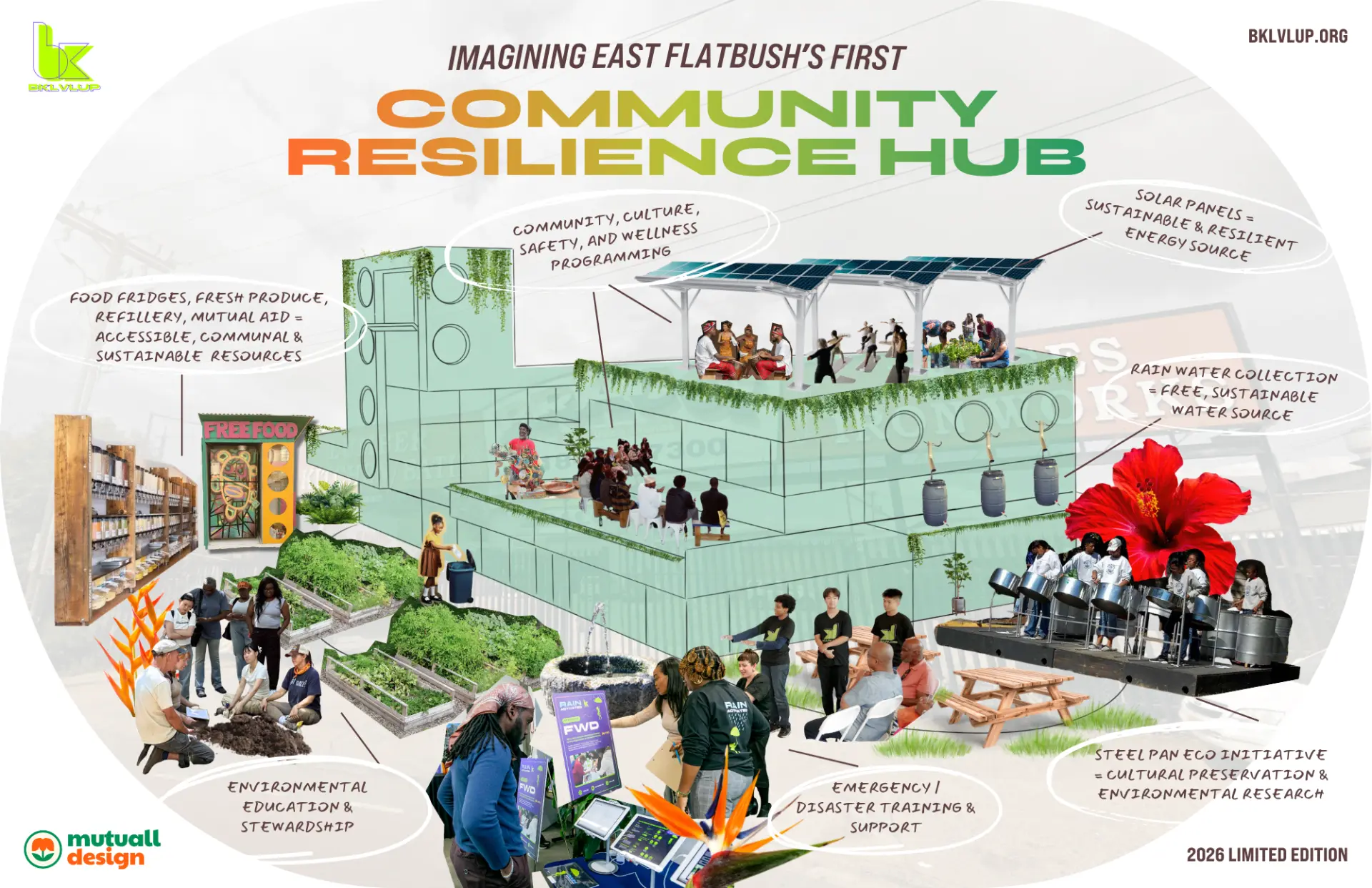
BKLVLUP is building Brooklyn's first Community Resilience Hub — a physical space anchored on Utica Avenue, open year-round, built around emergency support, food, shelter, water, and community programming. Most resilience hub surveys are written in English only, designed by professionals for professionals, and never reach the people they're supposed to represent. Before construction, before programming, before anything — the community needed to be heard.
The Research Foundation
The work was grounded in the six-pillar resilience hub framework — programs and services, information and connectivity, built and natural spaces, power systems and backup, operations and maintenance, and accessibility and transportation — layered with Flats-specific data: the NYC Heat Vulnerability Index, DOH Heat Risk dashboards, and the NYS Disadvantaged Communities Assessment Tool. One finding shifted everything: heatstroke is the leading environmental cause of death for NYC seniors. That moved cooling and elder access from nice-to-have to must-design-for.
What We Built
BKLVLUP's first multilingual Community Resilience Hub survey — completed in English, Spanish, and Haitian Creole, live and collecting responses. Each version was built and tested by Operators with those language skills, with attention to reading level and format accessibility, not just translation. The team also prepared field canvassing scripts — tested, plain-language pitches for stopping residents and explaining the Hub before going into the field.
My Role
As part of the cohort fieldwork, I developed and tested community outreach scripts for the survey — practicing how to explain the Resilience Hub in plain language and actually listen to what residents said back. It's the same skill as the street interviews: the question only works if the person answering it feels heard.
Skills Used
Community survey design · Multilingual outreach · Accessible communication design · Street interviewing and community listening · Qualitative research and data synthesis
Impact
The survey is live in three languages, with in-person feedback gathered at National Night Out at the Shirley Chisholm Center. The next step is expanding in-person collection as the Hub moves from concept to construction.
Group Project · EcoPower '26
Infrastructure Mapping & Street Interviews: The Flats
Live map — 11 stops across East Flatbush, Remsen Village & Canarsie
Infrastructure Mapping & Street Interviews: The Flats
Project visual coming soon
The Challenge
The Flats holds a 40-year-old Caribbean market, substations serving thousands, green spaces, and institutions people walk past every day without knowing what they are. When gentrification comes for a neighborhood, it comes first for the things nobody wrote down — and there was no shared record of either the infrastructure or the residents' account of it.
My Role & Contribution
I co-led the street interview framework with Jay and Carlisha: writing the questions, testing them, and running interviews near Brooklyn College. The script took rounds of practice — as Ground3D's Wil put it, you can't open with 'do you live here?' in New York City. On the mapping side I documented energy infrastructure along the corridor, working live in a shared Felt map where multiple Operators dropped points and wrote annotations together. I also filmed the group's closing video — three takes, because the audio didn't record the first time and I offered to do it again.
The Map
Every point on the map was annotated in full narrative sentences, so someone could pull it up on a phone and get a story, not coordinates. The walking route was assessed on foot for shade cover, water access, and flood risk, and the team began identifying corridor businesses for a community pact — places that could serve as cooling, charging, water, and information sites during a blackout or storm.
What I Discovered
“Spending half my summer in the Flats taught me how communities work, what young people need, and how strong bonds are formed. Learning about environmental racism, flooding, and air quality broadened my view of the world.”
Impact
Published as The Green Book: Energy Resilience Edition — 11 stops across East Flatbush, Remsen Village & Canarsie, hosted by Ground3D and navigable from a phone. The interview findings and community pact research feed the Flats Rising Communication Strategy (BKLVLUP × Ground3D × OEM/COAD).
Field Work
Additional Work
Thrash film resilience analysis — named the children left alone in floods, called for designated shelter spaces, and flagged fear-mongering in news coverage
Tested soil quality in an East Flatbush backyard
Attended a Brownfields conference and co-designed a community data intake survey
Discussed environmental racism during the Philadelphia trip
Coordinated with Mel and Rose on fans for the Community Report Back — logistics all the way to the end
Cross-track environmental data research alongside Community & Civic fieldwork